Google E-E-A-T Explained: Why Trust Matters More Than Ever in SEO
Over the last few years, Google’s search algorithms have undergone a major transformation.
There was a time when ranking on Google was largely about keywords, backlinks, and technical optimization. While these factors still matter, Google now evaluates content through a broader lens: Can users trust the information they are reading?
This shift has become even more important with the rise of AI-generated content. Today, anyone can generate hundreds of articles within hours. As a result, Google needs better methods to distinguish genuine expertise from content created solely to rank in search results.
This is where E-E-A-T comes into play.
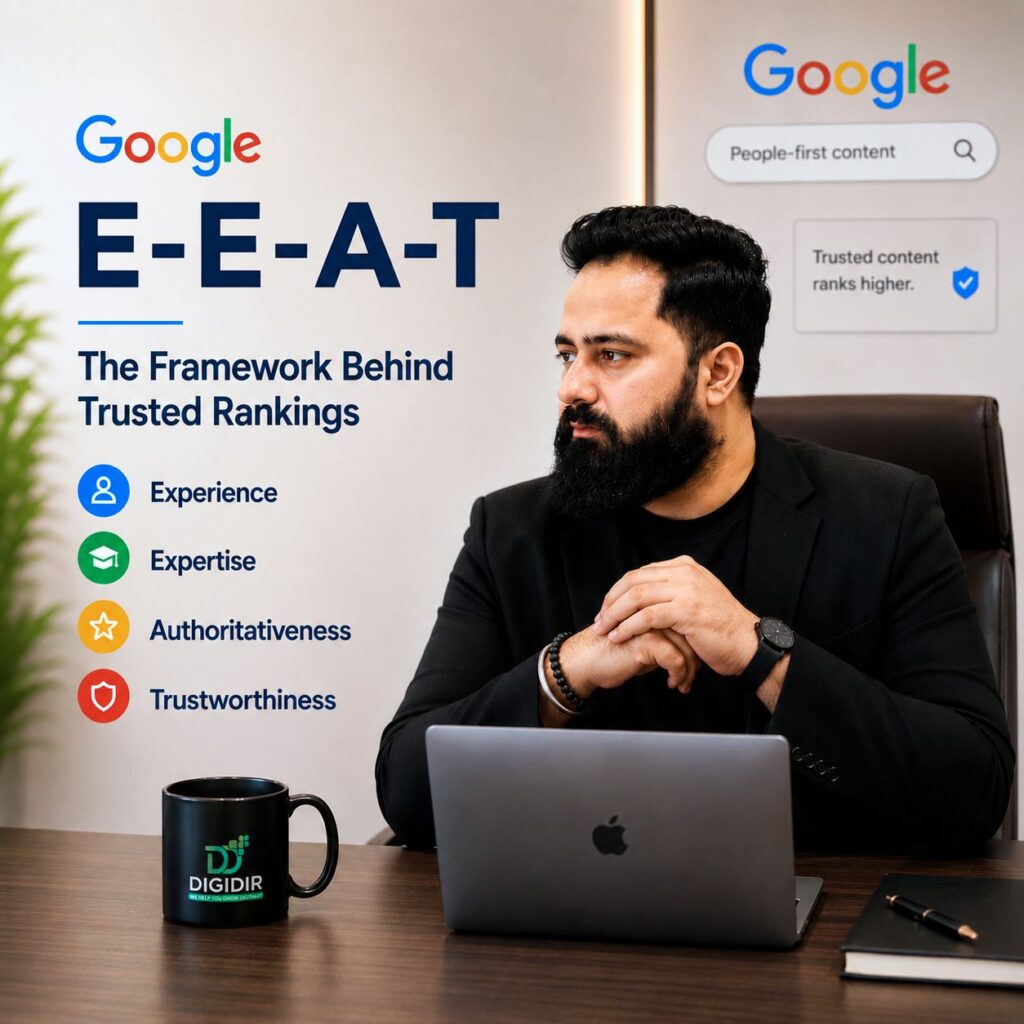
E-E-A-T stands for Experience, Expertise, Authoritativeness, and Trustworthiness. It is a quality framework used by Google to evaluate whether content provides genuine value to users.
Although E-E-A-T is not a direct ranking factor, it influences how Google’s systems identify and reward high-quality content.
For businesses, marketers, consultants, and website owners, understanding E-E-A-T has become essential for long-term search visibility.
What is E-E-A-T?
Google introduced E-A-T (Expertise, Authoritativeness, Trustworthiness) years ago within its Search Quality Rater Guidelines.
In late 2022, Google added another “E” for Experience, creating E-E-A-T.
The addition reflects Google’s increasing focus on firsthand knowledge and real-world experience.
For example:
A travel blogger who has personally visited Bali provides stronger signals than someone who summarizes information collected from other websites.
A restaurant consultant who has opened multiple restaurants offers greater value than someone who only writes theoretical articles about restaurant operations.
A digital marketing agency that publishes actual campaign results demonstrates stronger credibility than a website repeating generic SEO advice.
The fundamental question Google is trying to answer is:
“Would users trust this content enough to make important decisions based on it?”
The Four Pillars of E-E-A-T
1. Experience
Experience refers to firsthand involvement with the topic.
Google wants to understand whether the content creator has personally interacted with the subject they are discussing.
Examples include:
- Using a product before reviewing it
- Visiting a destination before recommending it
- Running advertising campaigns before sharing marketing advice
- Building websites before writing about web development
Why does this matter?
Because firsthand experiences often provide details, challenges, insights, and observations that generic content cannot replicate.
A review written by someone who actually used a software tool for six months is likely to be more valuable than a review generated from publicly available information.
In today’s AI-driven content landscape, experience is becoming one of the strongest differentiators.
2. Expertise
Expertise measures the depth of knowledge possessed by the content creator.
This does not always mean formal qualifications.
For example:
A certified financial advisor demonstrates expertise through education and credentials.
A professional chef demonstrates expertise through years of culinary experience.
A digital marketing consultant demonstrates expertise through successful campaign execution and industry knowledge.
Google evaluates expertise through signals such as:
- Author qualifications
- Professional experience
- Industry recognition
- Quality and accuracy of content
- Depth of topic coverage
The more complex the topic, the more expertise Google expects to see.
3. Authoritativeness
Authoritativeness is about reputation.
It answers questions such as:
- Do other experts mention this website?
- Is the brand recognized within its industry?
- Are authoritative websites referencing the content?
- Is the creator considered a trusted source?
Authority is often built through:
- High-quality backlinks
- Media mentions
- Industry awards
- Conference speaking engagements
- Expert interviews
- Guest appearances
- Thought leadership content
Think of authority as digital reputation.
When respected organizations consistently reference your work, Google gains confidence in your credibility.
4. Trustworthiness
Trustworthiness is the most important element of E-E-A-T.
Google’s own documentation emphasizes that trust is central to evaluating content quality.
A website can appear authoritative and knowledgeable, but if users cannot trust it, the value of the content diminishes significantly.
Trust signals include:
- Accurate information
- Transparent business details
- Clear contact information
- Secure HTTPS websites
- Honest reviews
- Updated content
- Factually correct claims
- Transparent author information
For e-commerce websites, trust also includes:
- Secure payment systems
- Return policies
- Customer support details
- Genuine customer reviews
Without trust, experience, expertise, and authority become far less meaningful.
Why E-E-A-T Matters for YMYL Websites
Google places special emphasis on E-E-A-T for YMYL topics.
YMYL stands for “Your Money or Your Life.”
These are topics where inaccurate information could negatively impact a person’s:
- Health
- Finances
- Safety
- Legal standing
- Well-being
Examples include:
- Medical advice
- Financial planning
- Investment guidance
- Insurance information
- Legal content
- Tax advice
- Safety procedures
If a website publishes incorrect health advice or misleading financial recommendations, the consequences can be severe.
Because of this, Google’s systems apply much stricter quality standards to YMYL content.
The higher the risk associated with a topic, the stronger the E-E-A-T signals required.
How AI Has Increased the Importance of E-E-A-T
The explosion of AI content has fundamentally changed search.
Many websites now publish hundreds of articles every month using AI tools.
The challenge is that AI can often produce content that sounds accurate without actually being accurate.
Google has repeatedly stated that it does not penalize content simply because AI was involved.
However, Google does reward helpful, accurate, trustworthy content regardless of how it was created.
This means:
AI-generated content without expertise is unlikely to perform well long term.
AI-assisted content backed by genuine experience and expert review can perform exceptionally well.
The future belongs to businesses that combine AI efficiency with human expertise.
Practical Ways to Improve E-E-A-T
Create Detailed Author Profiles
Every article should include:
- Author name
- Professional background
- Industry experience
- Certifications
- Social profiles
- Portfolio links
Users and search engines should clearly understand who created the content.
Publish Case Studies
Case studies demonstrate real-world experience.
Examples:
- SEO campaign results
- Lead generation improvements
- Website redesign outcomes
- Revenue growth examples
Actual experiences build credibility faster than generic advice.
Include Original Insights
Avoid simply repeating information already available online.
Share:
- Lessons learned
- Mistakes made
- Industry observations
- Personal experiences
- Unique frameworks
Original insights strengthen experience signals.
Cite Reliable Sources
Support important claims with references from:
- Government websites
- Academic institutions
- Industry reports
- Official organizations
- Research publications
This increases trustworthiness.
Improve Website Transparency
Include:
- About Us page
- Contact Us page
- Privacy Policy
- Terms and Conditions
- Team information
Transparency reassures both users and search engines.
Keep Content Updated
Outdated information damages trust.
Regularly update:
- Statistics
- Industry trends
- Examples
- References
- Screenshots
Freshness improves content reliability.
The Future of SEO: Trust as a Competitive Advantage
As AI-generated content continues to flood the internet, trust will become one of the strongest competitive advantages in search.
Businesses that rely solely on content volume may see short-term gains.
Businesses that invest in credibility, expertise, and real-world experience are more likely to achieve sustainable rankings.
The future of SEO is not simply about producing more content.
It is about producing content that people trust.
Google’s E-E-A-T framework is a clear indication of where search is heading.
The brands that demonstrate genuine experience, proven expertise, industry authority, and trustworthiness will be best positioned to win in both traditional search engines and AI-powered search experiences.
Final Thoughts
E-E-A-T is not a checkbox and it is not a direct ranking score.
It is Google’s way of identifying content that genuinely helps users make informed decisions.
Whether you run a business website, an e-commerce store, a consultancy, or a content platform, building E-E-A-T should be a core part of your digital strategy.
In a world where anyone can create content, credibility has become the real differentiator.
And in Google’s eyes, trust remains the foundation of everything.